
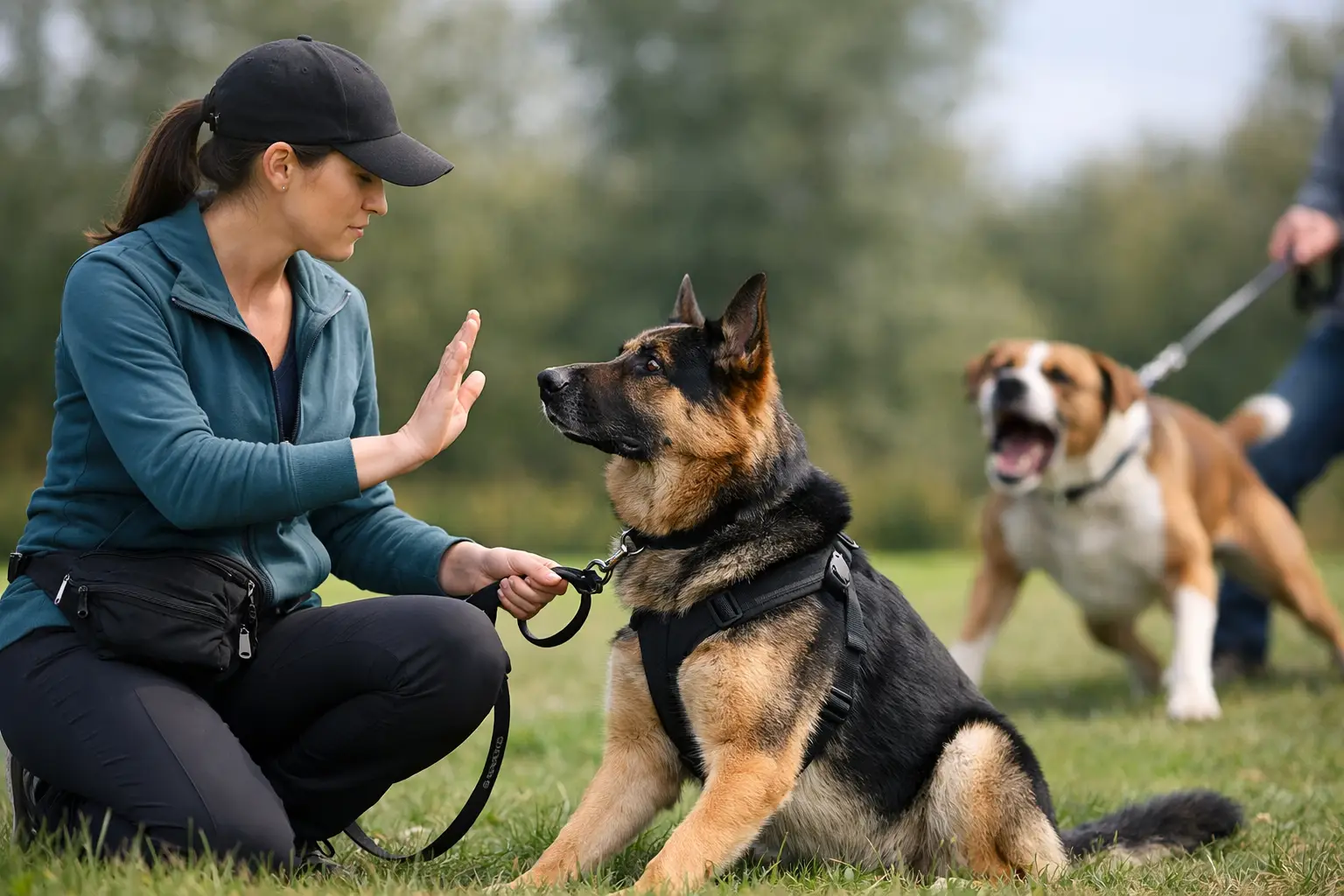
One bad walk can change the whole day. Your dog sees another dog, stiffens, starts barking and lunging, and suddenly you are gripping the leash, apologizing to strangers, and wondering why nothing seems to help. Dog reactivity training is built for exactly this problem. It gives dogs clearer communication, better coping skills, and practical structure so they can make better choices in the moments that used to send them over threshold.
Reactivity is common, but that does not make it simple. Some dogs react from fear. Some are frustrated and overexcited. Some have learned a pattern that gets repeated so often it becomes automatic. The behavior may look similar from the outside, but the training plan should match the dog in front of you, the level of intensity, and the situations that trigger the outburst.
What dog reactivity training actually means
Dog reactivity training is not just teaching a dog to stop barking. It is a process of changing how the dog responds to triggers while building obedience and handler control that hold up in real life. That usually means working on timing, leash handling, threshold awareness, impulse control, and clear follow-through.
For many owners, the biggest surprise is that reactivity work is rarely about one magic technique. It is about creating a more reliable dog overall. If your dog cannot focus around mild distraction, cannot settle, or does not understand how to respond to leash pressure and direction, those gaps will show up fast when a trigger appears.
This is why strong reactivity training often starts with foundation skills. Place, heel, recall, sit, down, and calm duration are not random obedience exercises. They are tools that give your dog a job and give you a way to guide behavior before the reaction takes over.
Why reactive behavior gets worse without structure
Reactive dogs tend to rehearse the same sequence. They notice the trigger, become fixated, build intensity, explode, and then eventually come down. Every repetition strengthens that habit. Even if the dog seems to calm down after the other dog passes, the pattern has still been practiced.
Owners often try to manage this by avoiding triggers completely, and sometimes that is necessary in the short term. But avoidance alone usually does not teach the dog what to do instead. On the other side, forcing too much exposure too soon can backfire and make the dog more defensive or more frantic. That is where professional guidance matters.
The goal is not to flood the dog with stress. The goal is to work at the right level of challenge, where the dog can stay engaged, receive direction, and learn a better response. That takes judgment, consistency, and a training plan that progresses in the right order.
The foundation behind effective dog reactivity training
A good program starts by identifying what the dog is reacting to, how close the trigger can be before the dog loses control, and what the dog already understands. A dog that is reactive on walks but responsive in the home needs a different starting point than a dog that struggles everywhere.
From there, training typically focuses on three areas at once. The first is communication. The dog needs to understand markers, leash guidance, body positioning, and obedience commands with enough clarity that those skills still matter outdoors.
The second is state of mind. A reactive dog is not just making a bad choice in a vacuum. The dog is escalating mentally and physically. Training has to address arousal, not just visible behavior. That means teaching the dog how to hold positions, move with purpose, disengage from fixation, and settle faster after excitement.
The third is proofing. Dogs do not generalize well on their own. A dog that can heel perfectly in the driveway may still fall apart near a busy trail, coffee shop patio, or neighborhood corner where other dogs appear unexpectedly. Real progress happens when the dog learns to succeed in gradually more difficult environments.
Timing and distance matter more than most owners realize
If you wait until your dog is already barking and lunging, the training window is smaller. The better opportunity usually comes earlier, when your dog first notices the trigger and begins to load up. That moment might be a hard stare, closed mouth, forward posture, or a sudden stop. Reading those signs lets you interrupt the pattern before it becomes an outburst.
Distance matters just as much. If your dog can stay responsive 40 feet away but not 15 feet away, that is useful information. Training should start where the dog can still think, not where the dog is guaranteed to fail. As the dog improves, that distance can shrink.
Obedience is not separate from behavior work
Owners sometimes worry that obedience is too basic for a reactive dog. In reality, obedience is often what makes behavior modification possible. A dog that understands how to heel past a distraction, hold place while activity happens nearby, or recall out of fixation has more pathways to success.
That does not mean obedience alone solves every case. Severe fear, defensive aggression, or long-standing reactive patterns may require a more intensive approach. But without handler control and consistent follow-through, even good desensitization work tends to stall.
Common mistakes that slow progress
One mistake is expecting fast fixes after a few better walks. Reactivity often improves in layers. The dog may stop exploding as often before the dog truly feels neutral. That is progress, but it still needs reinforcement.
Another mistake is inconsistency between sessions. If the dog is held to one standard during training and a completely different standard during regular walks, the picture becomes muddy. Dogs learn from repetition, and they also learn from loopholes.
A third issue is misreading the dog. Excitement and fear can look similar. So can confidence and tension. If the plan is based on the wrong motivation, results are slower and setbacks are more likely. This is one reason experienced evaluation matters, especially for dogs that show intense reactions, redirected frustration, or unpredictable behavior.
What professional training changes
Professional dog reactivity training gives owners more than a few exercises. It gives them a system. That includes knowing how to structure walks, when to redirect, how to avoid accidental reinforcement, how to create better exposure setups, and how to stay calm and clear when the dog starts to escalate.
For many families, the challenge is not willingness. It is bandwidth. They have jobs, kids, schedules, and a dog that practices reactive behavior every day. A structured training program can speed up progress by giving the dog repetitions in the right conditions and teaching the owner how to maintain those gains at home.
That is especially valuable for dogs whose reactivity affects daily life in a serious way. Maybe guests cannot come over without chaos. Maybe walks happen only at odd hours to avoid other dogs. Maybe the owner is physically struggling to control the dog. Those are quality-of-life problems, and they deserve a practical solution.
At Sit Means Sit Dog Training Austin, this is where format matters. Some dogs benefit from private lessons with owner coaching from day one. Others need a more immersive program, such as day training or board-and-train, to establish reliability faster before transferring those skills back to the owner. The right option depends on the dog’s behavior, the owner’s experience, and how quickly the issue needs to be brought under control.
What success looks like in real life
Success does not always mean your dog wants to greet every dog or ignore the world completely. For many reactive dogs, success means they can move through the world with control, clarity, and far less stress. They can see a trigger, stay responsive, and recover quickly instead of spiraling.
That kind of change can be life changing for owners. Walks become manageable. Public outings become possible. The relationship improves because communication improves. You stop feeling like every trigger is a crisis and start feeling like you can lead your dog through it.
The timeline depends on the dog. Mild reactivity with good owner follow-through may improve quickly. More serious cases take longer and usually require tighter structure. Either way, the goal is the same – not temporary suppression, but better behavior that holds up where you actually live.
If your dog is reacting on walks, at windows, around guests, or near other dogs, waiting usually does not make it easier. The pattern gets practiced, and the stress around it grows for both ends of the leash. The good news is that reactive behavior is trainable when the plan is clear, the timing is right, and the work happens in the real situations that matter most.