
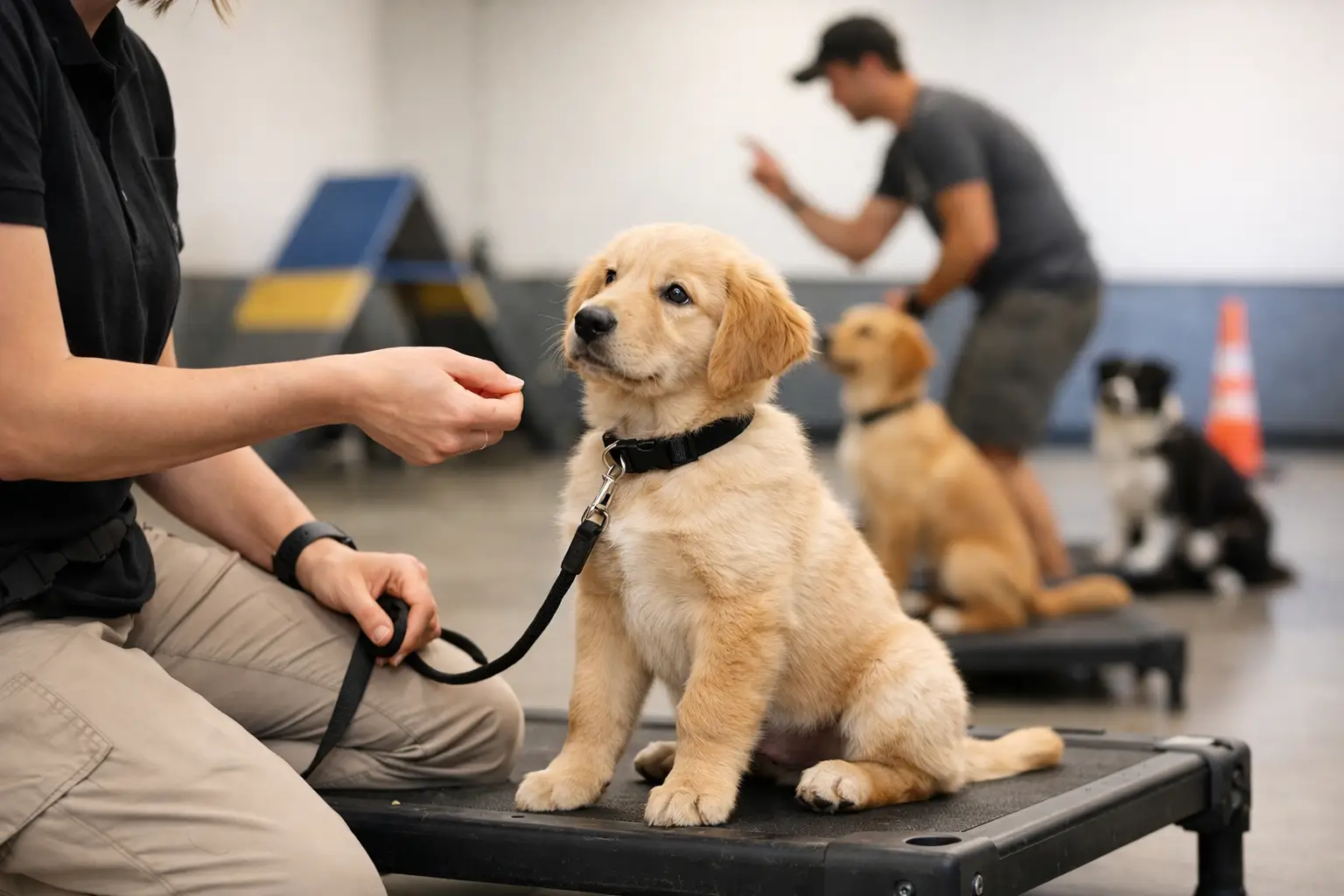
Bringing home a puppy is exciting right up until your mornings start with accidents, your evenings end with nipping, and every walk feels more like chaos than progress. That is usually when pet owners start asking about board and train programs for puppies and whether they are a smart shortcut or a serious training investment.
The honest answer is that it depends on the program, the puppy, and what you want the outcome to look like. A good puppy board-and-train program is not about sending your dog away and hoping they come back “fixed.” It is about creating structure early, teaching clear communication, and giving your puppy a strong foundation while making sure you know how to maintain it at home.
What board and train programs for puppies actually do
At their best, board and train programs for puppies give young dogs concentrated practice in the skills that matter most for daily life. That usually includes crate training, potty routines, leash manners, basic obedience, marker training, social stability, impulse control, and confidence in new environments.
The biggest advantage is consistency. Puppies learn fast, but they also rehearse bad habits fast. If a puppy spends every day jumping, biting hands, ignoring cues, and pulling toward distractions, those behaviors become stronger. In a structured training setting, the puppy gets repeated reps with clear timing, accountability, and follow-through.
That matters because most owners are not failing from lack of effort. They are busy. They are juggling work, kids, schedules, and sleep deprivation while trying to raise a dog that has no idea what the rules are yet. A board-and-train program can compress early learning and prevent common puppy issues from becoming long-term problems.
When a puppy board-and-train program makes sense
This format is often a strong fit for owners who want a head start and do not want to spend months correcting preventable habits. It can also be a great option for first-time puppy owners who need professional guidance, not just YouTube tips and trial-and-error.
Puppies that are highly energetic, easily overstimulated, mouthy, or already showing early signs of reactivity can benefit from a more controlled learning environment. So can puppies in homes where consistency is difficult because different family members are handling the dog in different ways.
That said, not every puppy needs to board for training. Some do very well with private lessons, day training, or a hybrid format where the puppy gets professional work during the day and continues learning with the family at home. The right answer depends on your goals, your schedule, your puppy’s temperament, and how much hands-on support you want.
What puppies should learn during board and train
A quality puppy program should focus on life skills, not party tricks. Sit and down are useful, but they are not the whole picture. What most owners actually need is a puppy that can settle, listen, and respond when real life is happening.
That means training should include engagement around distractions, calm behavior in and out of the crate, leash walking without constant pulling, place training, recall foundations, and clean transitions between activity and rest. Puppies also need to learn how to handle frustration, wait for direction, and recover when something unfamiliar shows up.
Socialization should be handled carefully too. Good socialization is not just letting puppies meet every dog and person they see. It is teaching them how to stay neutral, confident, and responsive in new situations. For many puppies, that is far more valuable than uncontrolled play.
The biggest misconception about board and train programs for puppies
The most common misunderstanding is that training only happens with the dog. It does not. The owner is part of the program.
If a puppy learns clear expectations with a trainer but comes home to inconsistent rules, the progress will fade. That is why the best programs include transfer lessons, coaching, and practical instruction for the family. You need to know how to guide your puppy through doorways, how to reinforce commands, how to prevent backsliding, and how to stay consistent without turning daily life into a struggle.
This is where results-driven training stands apart from a simple boarding stay. The goal is not temporary obedience in a facility. The goal is reliable behavior at home, on walks, around guests, and in the places you actually go.
How to judge a puppy board-and-train program
Not all programs are built the same, and this is where owners need to ask better questions.
Start with the structure. What exactly will your puppy be taught, and how is progress measured? Vague promises are a red flag. A professional trainer should be able to explain the skills, routines, and standards your puppy will work on.
Then ask how owner education works. If there is no clear handoff process, the program is incomplete. Your puppy may perform well for the trainer, but that does not help much if you are sent home with no plan.
You should also ask about the training environment. Puppies need structure, but they also need age-appropriate expectations. A strong program builds confidence while teaching accountability. It does not overwhelm young dogs or treat every puppy exactly the same.
Finally, look at whether the training reflects real life. Puppies do not live in a vacuum. They need to listen with distractions, settle around activity, and function in everyday routines. A program that only works in one setting is limited.
The trade-offs to consider
Board-and-train can accelerate progress, but it is not magic. One trade-off is that you are not the person doing the first round of repetition with your puppy. For some owners, that is a relief. For others, it feels like missing part of the bonding process.
There is also the question of age and readiness. Very young puppies may benefit more from a puppy-specific day training or hybrid format than from a longer residential stay. The key is matching the program to the puppy’s developmental stage rather than forcing a one-size-fits-all solution.
Cost is another factor. Board-and-train is usually a bigger investment up front than private lessons. But if it creates faster progress, prevents entrenched behavior issues, and gives you a better system to maintain results, it can save time and frustration in the long run. The cheapest option is not always the most efficient one.
Why follow-through matters more than the initial program
The real test starts when your puppy comes home.
That is when structure has to continue during feeding, potty breaks, greeting guests, neighborhood walks, and quiet time in the house. Puppies thrive on clarity. If the rules change every day, they will test every opening you give them.
That is why support after the program matters so much. Ongoing coaching, reinforcement sessions, and access to group practice can make the difference between short-term improvement and lasting reliability. A strong training system does not just produce a better-behaved puppy for a week. It gives the owner a framework to keep building.
For Austin-area families looking for practical results, this is exactly why a consultation matters. The right trainer should assess your puppy, your lifestyle, and your goals before recommending whether board-and-train, day training, private lessons, or a hybrid option makes the most sense. At Sit Means Sit Dog Training Austin, that kind of tailored recommendation is part of getting owners into the right program instead of the most convenient sales pitch.
Are board and train programs for puppies worth it?
They are worth it when the program is structured, the expectations are realistic, and the owner stays involved. They are especially valuable when you want to build obedience early, prevent bad habits from taking root, and create calm, reliable behavior that fits into real life.
They are not worth it if you expect training to happen without your participation, or if the provider cannot clearly explain how your puppy will learn and how you will maintain that learning at home.
The best puppy training does not just produce a dog that follows commands. It produces a dog that can live well with your family, handle the world with more confidence, and respond when it counts. If a board-and-train program can deliver that and give you the skills to keep it going, it is not a shortcut. It is a strong start.