
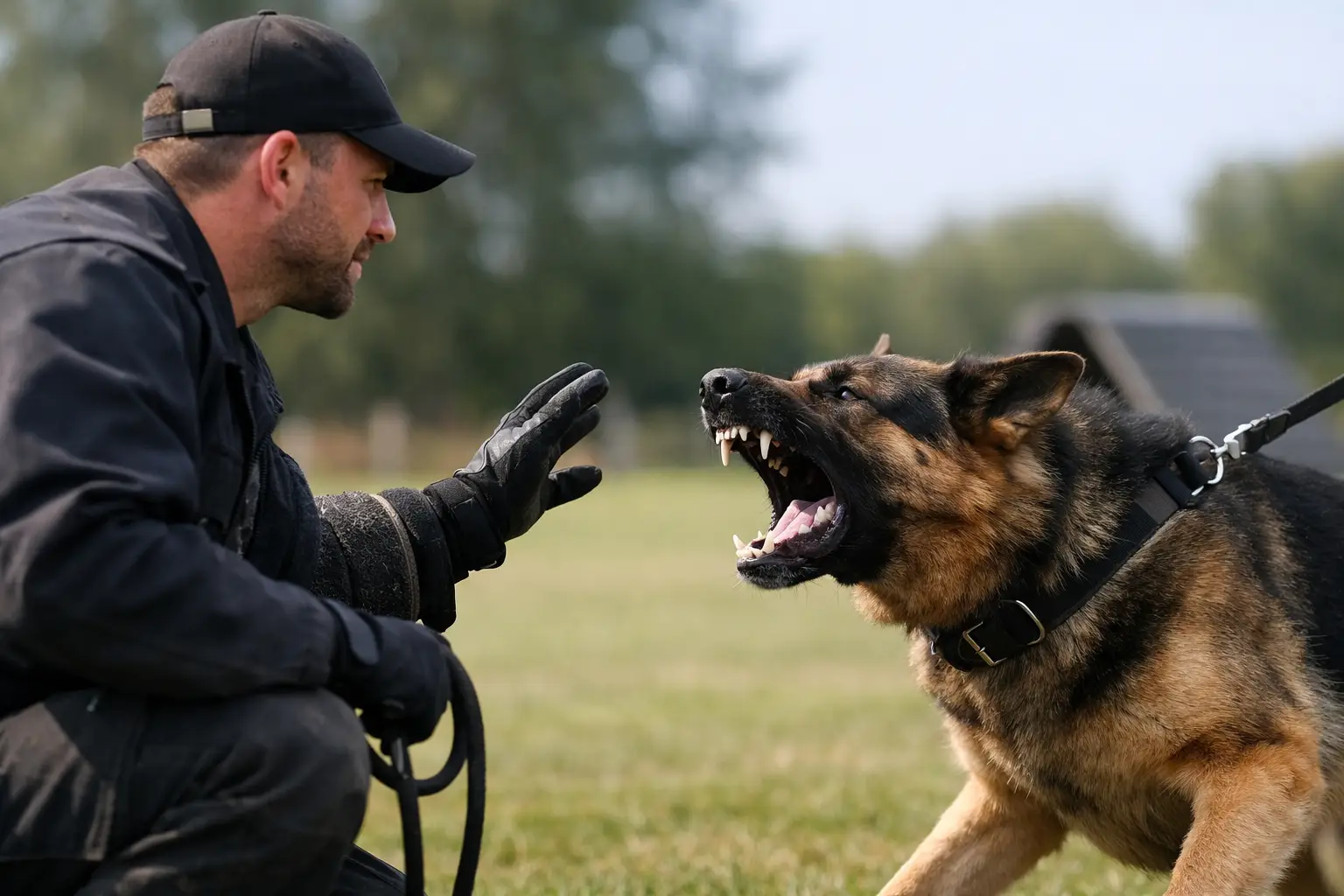
When your dog growls at guests, lunges on walks, or snaps when handled, the problem stops feeling theoretical fast. Aggressive dog training is not about overpowering a dog or hoping the behavior fades with age. It is about identifying why the behavior is happening, building clear communication, and creating safer, more reliable responses in real life.
That matters because aggression is not one-size-fits-all. A dog that guards food has a different training path than a dog that explodes at the sight of other dogs. A fearful dog may look aggressive, but the emotional driver is very different from a confident dog that has learned aggressive behavior works. If you want lasting improvement, the plan has to match the dog in front of you.
What aggressive dog training really means
A lot of owners come in expecting one fix for every aggressive behavior. In reality, aggressive dog training is behavior modification backed by structure, repetition, and owner education. The goal is not to suppress warning signs and hope for the best. The goal is to change the dog’s response patterns while giving the owner better control, better timing, and better decision-making.
That usually starts with identifying the type of aggression involved. Some dogs are reacting out of fear. Some are guarding space, food, toys, or people. Some become aggressive when frustrated or overstimulated. Others have poor impulse control and a long history of rehearsing the same unwanted behavior. In some cases, pain or an underlying medical issue is part of the picture, which is why a thorough evaluation matters.
The good news is that dogs can improve dramatically with the right system. We have seen aggressive dogs learn to move through daily life with far more stability, focus, and reliability. But real progress comes from a plan, not guesswork.
Why aggression shows up in the first place
Owners often ask the same question: Why is my dog acting like this now? Sometimes the answer is obvious, and sometimes it is not. Genetics, early social experiences, inconsistent boundaries, stressful environments, accidental reinforcement, and lack of clear leadership can all contribute.
A dog that is allowed to bark, lunge, and drive people or dogs away may learn that aggressive displays are effective. A nervous dog may discover that growling creates distance and start using that strategy more quickly. A highly aroused dog may tip into aggression because there is no practiced off switch. In each case, behavior is shaped by repetition.
This is where training has to be honest. Love your dog, absolutely. But affection alone does not solve aggression. Neither does avoiding every trigger forever. Most owners need a system that teaches the dog what to do instead, and teaches the human how to interrupt unsafe patterns before they escalate.
What effective aggressive dog training includes
The strongest programs are built around control, clarity, and transfer into everyday situations. That means your dog does not just behave in a quiet room with a trainer. Your dog learns how to respond around doors, sidewalks, visitors, distractions, and the situations that actually matter.
Training usually begins with foundational obedience because obedience creates a language the dog can understand under stress. Place, heel, recall, down, and clear thresholds are not just nice skills. They give owners practical tools to redirect behavior, create space, and lower chaos.
From there, behavior modification work targets the aggressive response itself. That may include exposure at a level the dog can handle, improved leash handling, better timing on corrections and rewards, and repetition in controlled scenarios before moving into more difficult environments. The pace matters. Push too fast and the dog rehearses failure. Go too slowly without enough structure and the dog never develops new habits.
That is also why owner coaching is not optional. If a dog learns one set of rules with a trainer and a different set at home, progress stalls. Lasting results happen when training transfers into the owner’s routine.
Aggressive dog training is not the same for every household
This is where cookie-cutter advice falls apart. A retired couple with a dog that guards the couch needs a different strategy than a busy family managing reactivity at the front door. A young working breed with poor impulse control may benefit from a more intensive training format than a lower-drive dog with a narrow trigger pattern.
It also depends on your skill level, schedule, and urgency. Some owners are confident and consistent enough for private lessons with homework between sessions. Others need day training, board-and-train, or hybrid support to create faster momentum and tighter structure. None of those formats is automatically better than the others. The right choice is the one that fits the dog and gives the owner the best chance of following through.
For many Austin-area families, that practical fit matters just as much as the training theory. You need a plan that works with your home, your neighborhood, your schedule, and the situations where your dog is struggling.
What owners should stop doing
One of the biggest setbacks in aggression cases is accidentally reinforcing the behavior. If your dog barks, lunges, or growls and the trigger always goes away, the dog may believe that aggressive behavior solved the problem. If your dog only hears cues when things are calm, those cues will likely fall apart when stress rises.
Owners also run into trouble when they rely on constant avoidance. Management is important, especially for safety, but management alone does not teach new behavior. The goal is not just to survive around triggers. The goal is to build a dog that can respond appropriately when those triggers show up.
Another common mistake is waiting too long. Aggression rarely improves through wishful thinking. The longer a dog practices it, the more established it becomes. Early professional help often means fewer rehearsals, better safety, and faster progress.
Safety comes first during behavior work
Any aggression case should be handled with safety in mind. That means setting up environments carefully, using the right equipment, and avoiding situations where the dog is likely to go over threshold. It also means being realistic. Not every dog should be put straight into busy public spaces or chaotic social settings.
Good training protects everyone involved while the dog learns. That includes family members, visitors, other dogs, and the dog itself. Clear handling plans reduce risk and help owners stay calm, which matters more than most people realize. Dogs read human tension quickly.
This is also why professional guidance is valuable in true aggression cases. Timing, setup, and pressure level all matter. If those pieces are off, owners can unknowingly escalate the problem or create mixed signals that make the dog less stable.
What progress usually looks like
Progress in aggressive dog training is rarely a straight line. Many dogs improve in stages. First, the explosions become easier to interrupt. Then recovery gets faster. Then the dog starts offering better choices before the old behavior kicks in. Over time, the dog develops more consistent obedience, better impulse control, and more emotional stability around known triggers.
That kind of progress is real, but it still requires maintenance. Some dogs reach the point where aggression is largely resolved in day-to-day life. Others remain dogs that need thoughtful handling in certain situations. Both outcomes can be major wins if the household is safer and the dog is more reliable.
The key is setting the right expectation. Training can create major change, but success does not always mean your dog loves every stranger, every dog, or every environment. Sometimes success means your dog can stay responsive, under control, and safe when those things are present.
When professional help makes the biggest difference
If your dog has bitten, attempted to bite, guarded family members, redirected aggression onto a handler, or become impossible to control around triggers, professional help should move up the list quickly. These are not cases for internet advice and trial-and-error handling.
A qualified training team can assess what is driving the behavior, what safety measures are needed, and which training format gives you the best path forward. That is especially important when owners are emotionally exhausted, because aggression cases can wear people down fast. You need a process that replaces uncertainty with clear next steps.
At Sit Means Sit Dog Training Austin, that process starts with evaluating the dog in context and building a program around practical results. The point is not just to get through a lesson. The point is to help owners gain control, confidence, and a dog they can live with more safely and successfully.
Aggression can feel isolating, but it is a training problem that deserves a training plan. With the right structure, the right coaching, and a system built for real life, many dogs can make meaningful changes that restore peace at home and confidence on the leash.