
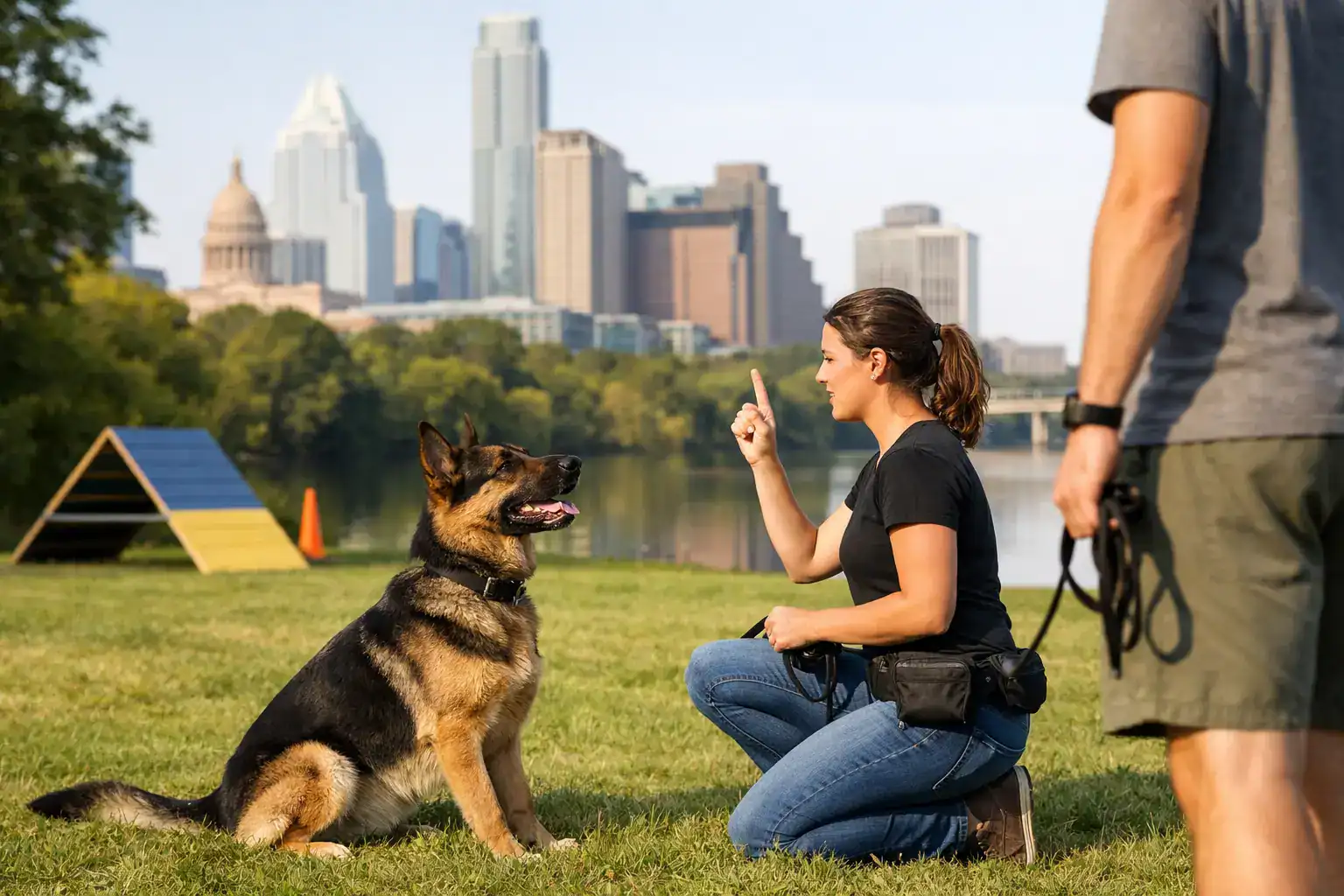
When people search for dog obedience training near me, they are usually not looking for theory. They are looking for help now – with the jumping, the pulling, the barking, the ignored commands, or the stress of not knowing what their dog will do in public. If that sounds familiar, the right training should do more than teach a few cues. It should give you control, clarity, and a dog that can function reliably in everyday life.
That is the standard worth looking for in Austin. Good obedience training is not about a dog performing perfectly in a quiet room. It is about getting real results in the places that matter most – your home, your neighborhood, around guests, near distractions, and out in the world.
What dog obedience training near me should actually include
A lot of owners start by searching locally because they want convenience. That makes sense. But location alone is not enough. The better question is whether the training program is built to solve the problems you are actually dealing with.
Basic obedience should cover the essentials, such as sit, down, place, come, leash manners, and staying engaged around distractions. But for most families, that is only part of the picture. Real obedience also means your dog can listen when the doorbell rings, settle when visitors come over, walk calmly past other dogs, and respond even when life is busy.
That is where many training options separate. Some classes teach commands in a controlled setting, but they do not always transfer well into daily life. A stronger program focuses on training as you live. That means your dog learns the behaviors, and you learn how to reinforce them in the environments where you need them most.
How to tell if a local trainer is the right fit
Not every dog needs the same format, and not every owner has the same schedule. A good trainer should be able to look at your dog, your goals, and your challenges, then recommend a program that makes sense instead of pushing a one-size-fits-all plan.
If you are evaluating dog obedience training near me, look for clear proof of experience. That includes years in business, a large number of dogs trained, and a track record with more than just easy cases. Puppies, adolescent dogs, adult rescues, reactive dogs, anxious dogs, and strong-willed dogs all require different handling skills.
You also want a trainer who can explain the process in plain language. You should know what your dog will learn, what your role will be, how progress is measured, and what support is available after the initial training period. If those answers are vague, that is a problem.
Strong obedience training should feel structured, not confusing. You should come away with a plan.
The best training format depends on your dog and your life
One of the biggest mistakes owners make is assuming there is one best way to train every dog. There is not. The right format depends on your dog’s temperament, behavior issues, age, and how much hands-on time you can realistically give.
Private lessons can be a great fit for owners who want direct coaching and want to be involved from the start. This format works well for teaching fundamentals, improving communication, and addressing home-specific challenges.
Day training is often a smart option for busy professionals or families who want faster momentum. Your dog gets consistent work from a professional trainer, while you still learn how to maintain those skills.
Board-and-train or hybrid stay-and-train programs can make sense when the issues are more advanced, the dog needs an immersive reset, or the owner wants a stronger training foundation built quickly. These programs are not a shortcut for owner involvement, but they can create major progress in a shorter window when paired with transfer sessions and follow-through.
For young dogs, puppy programs matter because early structure changes the entire trajectory. Housebreaking, crate training, socialization, leash introduction, confidence building, and impulse control all pay off later.
And for dogs struggling with aggression, fear, anxiety, or reactivity, obedience is still part of the answer, but the training needs to go beyond basic commands. Behavior modification requires a trainer who can address the root patterns while building safer, more reliable responses.
Why obedience training fails for some dogs
Most dogs are capable of learning. What usually fails is the system.
Sometimes the training is too inconsistent. The dog learns one standard with the trainer, another at home, and a third when guests are around. Sometimes the environment is too controlled, so the dog looks good in class but falls apart in the real world. And sometimes the owner is given commands to practice without enough coaching on timing, follow-through, and handling.
That is why owner education matters so much. A dog can make real progress in training, but if the owner is not shown how to lead, reinforce, and maintain those expectations, the results will not hold up.
The most effective programs teach both ends of the leash. They help the dog understand the rules, and they help the owner apply those rules with confidence.
What results should you expect?
You should expect improvement you can actually feel in daily life.
For some dogs, that means calmer walks, less chaos at the front door, and better listening at home. For others, it means reliable recall, stronger off-leash control, improved neutrality around distractions, or a safer response to triggers that used to create problems.
That said, results depend on the dog, the issue, and the level of follow-through. A puppy learning basic structure is a different case than an adult dog with a long history of reactivity. Both can improve, but the timeline and process will not look the same.
A trustworthy trainer will be confident without pretending every case is identical. They should be able to explain what is realistic, what will take more work, and what kind of consistency is needed from you.
What Austin dog owners should prioritize
Austin is full of distractions for dogs. Busy neighborhoods, patios, trails, parks, apartment living, visitors, kids, traffic, and other dogs all put obedience to the test. A training program that only works in a quiet room is not enough for this environment.
Local owners should prioritize trainers who build real-world reliability. That means practicing around distractions, teaching dogs to settle in stimulating spaces, and preparing owners to handle situations they actually face every week.
It also helps to choose a company that offers more than one level of support. Group classes, follow-up coaching, and reinforcement opportunities can make a big difference once the initial training is complete. Dogs do better when expectations stay clear over time.
For many Austin families, flexibility matters too. Some owners want full coaching. Others need more hands-on trainer involvement because of work schedules or because the dog’s behavior has become overwhelming. The right provider should be able to meet you where you are and move you forward.
Choosing a program with staying power
Good marketing can make any trainer sound impressive. What matters is whether the training holds up after the first few weeks.
Look for a company that has experience across obedience and behavior cases, offers multiple program formats, and backs up its claims with a strong history of results. Sit Means Sit Dog Training Austin has spent more than 12 years helping over 10,000 dogs, and that kind of volume matters. It tells you the team has seen the full range – from puppies needing structure to serious behavior cases that require a more strategic plan.
Just as important, the program should be designed for transfer. Your dog does not live with the trainer forever. The goal is a trained dog who can respond to you, in your routine, with your expectations.
That is what makes obedience training worth the investment. It is not about showing off commands. It is about creating a dog you can actually enjoy living with.
When to start
Sooner is usually better.
If your dog is still young, starting early helps prevent bad habits from taking root. If your dog is older and the problems have already become frustrating, training can still make a major difference. Age is rarely the real barrier. More often, the barrier is waiting until the behavior has become normal for the household.
If you have been searching for dog obedience training near me because things feel off track, that is reason enough to act. The right program can replace guesswork with a clear path and give both you and your dog a better way forward.
A well-trained dog changes everyday life in small but meaningful ways – calmer mornings, easier walks, less stress when guests arrive, and more confidence wherever you go together.