
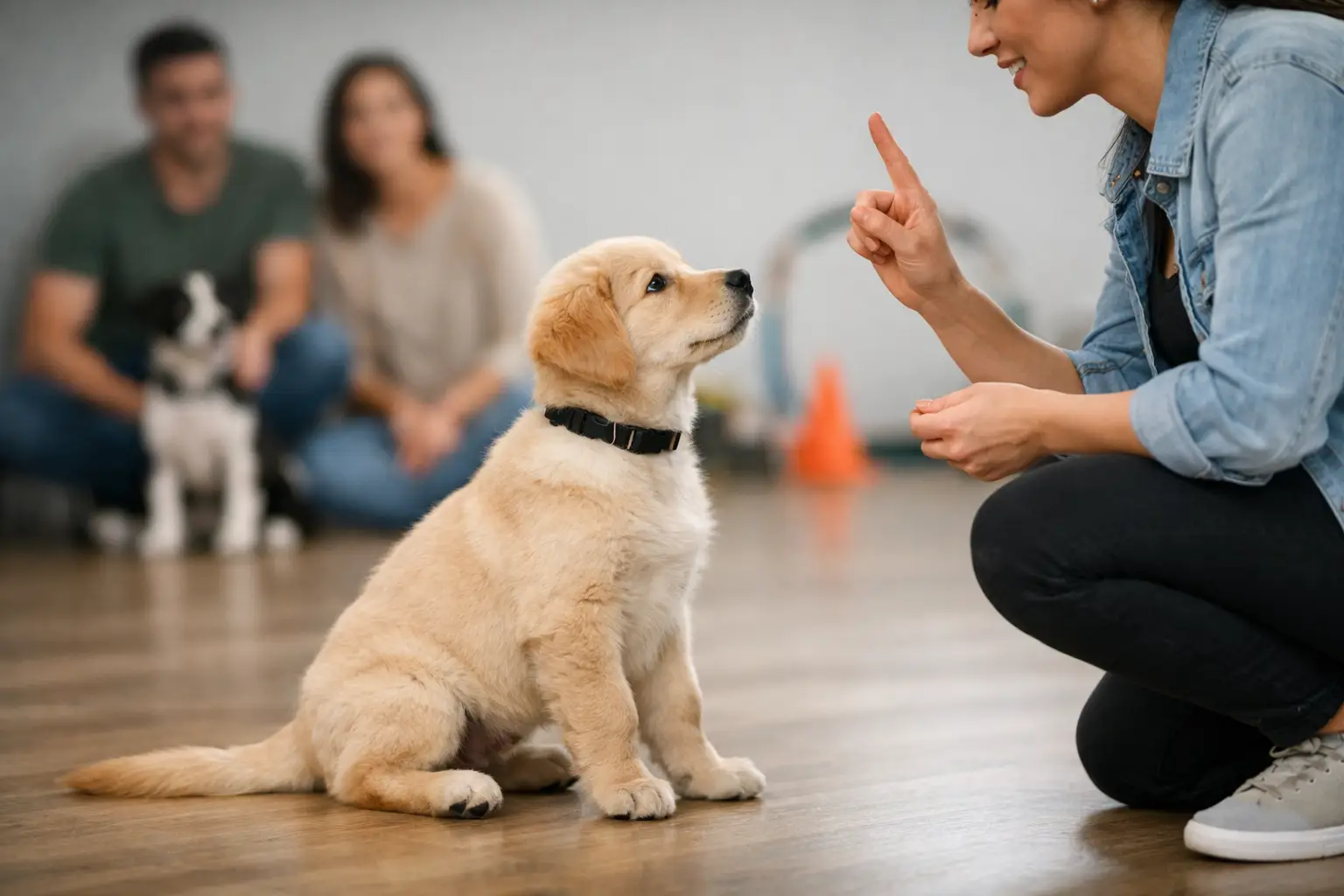
The first few weeks with a puppy usually look the same – chewed shoes, wild zoomies, accidents on the floor, and a lot of advice from a lot of people. That is usually when owners start asking, what is puppy obedience training, and do we really need it this early? The short answer is yes. Good puppy training is not about expecting perfect behavior from a baby dog. It is about building the habits, communication, and structure that shape how your dog behaves for years to come.
What Is Puppy Obedience Training?
Puppy obedience training is the process of teaching a young dog how to respond to clear commands, follow household rules, and stay engaged with their owner in everyday situations. It includes basic skills like sit, come, place, leash walking, and polite greetings, but it goes beyond commands. It also teaches impulse control, confidence, focus, and how to make good decisions around distractions.
That matters because puppies are always learning, whether you are training them or not. If they learn that jumping gets attention, pulling gets them where they want to go, and ignoring you has no downside, those behaviors become stronger fast. Obedience training gives that learning process direction.
At its best, puppy obedience training creates a dog that can live comfortably in the real world. That means better behavior in the house, safer behavior around people and dogs, and more freedom as your puppy grows up.
What Puppy Obedience Training Really Includes
A lot of owners hear the word obedience and picture a puppy robotically sitting on command. Real training is much more practical than that. The goal is not to make your dog stiff or shut down. The goal is to make communication clear so your puppy understands what is expected.
Most puppy obedience programs focus on foundation skills first. That often includes name recognition, leash manners, sit, down, come, place, crate training, and waiting politely at doors. Housebreaking and nipping may also be part of the process, because manners and obedience tend to overlap in real life.
Just as important, puppies learn how to handle stimulation without spinning out. That could mean staying calmer when guests come over, paying attention during a walk, or settling instead of bouncing from one bad choice to the next. For many owners, that kind of practical control is what makes daily life easier.
Why Start So Early?
Waiting until a puppy is older can make training harder than it needs to be. Young dogs are forming patterns every day, and early structure helps prevent small issues from turning into bigger ones.
That does not mean pushing a puppy too hard. Age matters. A ten-week-old puppy should not be trained like a mature adult dog, and expectations need to fit the dog in front of you. But there is a major difference between age-appropriate training and no training at all. Puppies can absolutely begin learning obedience, boundaries, and engagement early.
Early training also helps with confidence. Puppies go through developmental stages where the world can feel exciting one day and overwhelming the next. A structured training approach gives them a clear path through new environments, people, sounds, and routines. That is one reason obedience training often supports behavior as much as it supports commands.
What Puppy Obedience Training Is Not
It is not punishment for being a puppy. Chewing, mouthing, barking, and short attention spans are normal puppy behaviors. Training does not erase development. It gives you a system for guiding it.
It is also not just a class where your puppy learns to sit for treats in a quiet room. That can be a useful starting point, but most owners need more than that. A puppy that listens in the kitchen but falls apart on a walk is not fully trained. Reliable obedience has to transfer into real life.
That is where professional structure often makes the difference. Training should account for the way you actually live – your home, your schedule, your neighborhood, your distractions, and your goals for your dog.
The Skills That Matter Most
Some commands get more attention than others, but the most valuable puppy skills are usually the ones that improve safety, control, and daily function.
Come is one of the biggest. A puppy that turns and comes when called is safer in the yard, safer around open doors, and easier to manage as distractions increase. Place is another highly useful behavior because it teaches your puppy to settle on a designated spot instead of pacing, jumping, or crowding guests.
Leash walking matters because pulling is easier to prevent than to undo later. Sit and down help with impulse control, but only if the puppy can do them with some consistency beyond the living room. Waiting at thresholds, holding position briefly, and disengaging from distractions are also major parts of functional obedience.
The exact training plan can vary. A confident, high-drive puppy may need more impulse control work. A softer or more cautious puppy may need a confidence-building approach. Good training is never one-size-fits-all, even when the goals are similar.
How Professional Puppy Training Helps
Many owners can teach a few basics on their own. The challenge is usually consistency, timing, and follow-through. Puppies are fast learners when the message is clear, but they are just as fast at learning loopholes.
Professional puppy obedience training helps by creating structure from day one. Instead of guessing whether a behavior will pass on its own, you get a plan. Instead of repeating commands and hoping for the best, you learn how to handle the puppy in a way that makes the lesson stick.
That support matters even more for busy families and working professionals. If your schedule is packed, training can easily become inconsistent, and inconsistent training produces inconsistent dogs. A professional program can speed up progress and reduce frustration by giving both the dog and the owner a repeatable system.
At Sit Means Sit Dog Training Austin, that real-world approach is a big part of what makes puppy work effective. Training is built around everyday life, not just isolated drills, so owners can actually use what their puppy learns.
Different Training Formats for Different Owners
Not every puppy owner needs the same type of help. Some want private lessons so they can be involved from the beginning and learn alongside their dog. Others need day training or a board-and-train option because work and family schedules make daily practice harder to manage alone.
Neither option is automatically better. It depends on the puppy, the owner, and the goals. A highly motivated owner with time to practice may do well with coaching and homework. An overwhelmed owner dealing with nipping, accidents, and nonstop chaos may benefit from a more hands-on training format that creates momentum quickly.
The key is not choosing the most intense option. It is choosing the option that gives your puppy the best chance at consistent follow-through.
What Results Should You Expect?
You should expect progress, not instant perfection. Puppies are developing mentally and physically, and reliability takes repetition. Good training usually produces better responsiveness, better manners, and a calmer household fairly quickly, but polish comes with time.
You should also expect ongoing reinforcement. Training is not something you finish once and never revisit. Puppies grow, distractions change, adolescence kicks in, and new behaviors need support. That is normal. The goal is to build a strong enough foundation that future challenges are manageable instead of overwhelming.
If a training program promises results without owner involvement, be cautious. Even when professionals do a large part of the training, long-term success still depends on the owner understanding how to maintain it. The best programs train the dog and coach the human.
How to Know Your Puppy Needs Training Now
Most do. You do not need to wait for serious problems before getting help. In fact, the best time to start is usually before bad habits become the norm.
If your puppy is jumping, biting, pulling, ignoring you, struggling with crate time, or becoming overstimulated easily, training can help. If your puppy is sweet but distracted, that still counts. Obedience training is not only for difficult dogs. It is for owners who want a dog that listens, behaves well, and fits smoothly into daily life.
That is really the answer to what is puppy obedience training. It is not a luxury and it is not just a puppy class checklist. It is the foundation for a dog that understands how to live with you, respond to you, and succeed in the environments that matter most. Start early, stay consistent, and your puppy has a much better chance of becoming the dog you hoped for when you brought them home.